Obfuscated Netanix Ctf
Solving a custom obfuscation challenge using Base64 URL-safe decoding, 3-byte block reversal, and repeating-key XOR.
Challenge
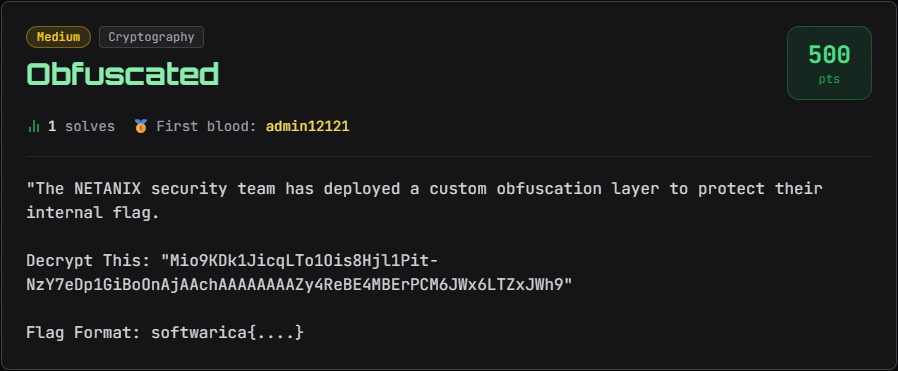
The challenge provided an obfuscated encoded string and required recovering the hidden flag.
The given ciphertext was:
Mio9KDk1JicqLTo1Ois8Hjl1Pit-NzY7eDp1GiBoOnAjAAchAAAAAAAAZy4ReBE4MBErPCM6JWx6LTZxJWh9At first glance, the string looked like an encoded value rather than direct encrypted text. The goal was to identify each transformation layer and reverse it in the correct order.
Analysis
The ciphertext contained characters commonly seen in Base64 URL-safe encoding, especially the - character. It also had no visible padding, which is common when Base64 output is used in compact formats.
After decoding the Base64 URL-safe layer, the output was still unreadable. This showed that another transformation had been applied before encoding.
By inspecting the decoded bytes, the data appeared to be rearranged in fixed-size groups. Testing small block sizes showed that reversing every 3-byte block produced a more structured byte sequence.
The final layer was a repeating XOR operation using the key:
NETANIXSo the complete decoding process was:
- Decode the ciphertext using Base64 URL-safe decoding.
- Reverse every 3-byte block.
- XOR the result with the repeating key
NETANIX.
Step 1: Base64 URL-safe decoding
The ciphertext first needed proper Base64 padding before decoding.
import base64

ciphertext = "Mio9KDk1JicqLTo1Ois8Hjl1Pit-NzY7eDp1GiBoOnAjAAchAAAAAAAAZy4ReBE4MBErPCM6JWx6LTZxJWh9"

padding = "=" * ((4 - len(ciphertext) % 4) % 4)
data = base64.urlsafe_b64decode(ciphertext + padding)
This produced raw bytes, but the result was still not readable plaintext.
Step 2: Reverse each 3-byte block
The decoded bytes were arranged in blocks of 3. Each block had to be reversed to restore the original byte order.
reordered = bytearray()

for i in range(0, len(data), 3):
    block = data[i:i + 3]
    reordered.extend(block[::-1])
This corrected the byte ordering before the XOR stage.
Step 3: Apply repeating-key XOR
The final layer used XOR encryption with the repeating key NETANIX.
key = b"NETANIX"

flag = ""

for i, byte in enumerate(reordered):
    flag += chr(byte ^ key[i % len(key)])

print(flag)
After applying the XOR operation, the plaintext flag was recovered.
Full Solver
import base64

ciphertext = "Mio9KDk1JicqLTo1Ois8Hjl1Pit-NzY7eDp1GiBoOnAjAAchAAAAAAAAZy4ReBE4MBErPCM6JWx6LTZxJWh9"
key = b"NETANIX"

padding = "=" * ((4 - len(ciphertext) % 4) % 4)
data = base64.urlsafe_b64decode(ciphertext + padding)

reordered = bytearray()

for i in range(0, len(data), 3):
    block = data[i:i + 3]
    reordered.extend(block[::-1])

flag = "".join(
    chr(byte ^ key[i % len(key)])
    for i, byte in enumerate(reordered)
)

print(flag)
Output | Flag
Running the solver prints:
softwarica{cust0m_0bfusc4t10n_w1th_NETANIX_k3y_1s_unbr34k4bl3!}Conclusion
This challenge used multiple simple obfuscation layers together. The ciphertext was first Base64 URL-safe encoded, then the decoded bytes were arranged using 3-byte block reversal, and finally the result was protected with a repeating-key XOR operation.
By reversing each layer in the correct order, the hidden flag was successfully recovered.